Health

|
|
|
|
|
home
|
to vargevass


  The Siberian Husky can be considered a sound breed in comparison to other breeds. Nevertheless there are some conditions known, of which most common are:


nn
  Eyedefects such as Other disorders like:
 
  • Cataract
  • Cornea Dystrophie
  • Glaucoma
  • Chronic Superficial Keratitis (Pannus)
  • Progressive Retina Atrophy (PRA)
  • Cryptorchism
  • Epilepsy
  • Hypothyroidism
  • Hipdysplasia
  • Zinc Responsive Dermatosis
  It would reach too far to extensively describe the above listed conditions on this site. They occur in all dog breeds rather than only in the Siberian Husky breed. The internet offers a wide variety of sites which give profound information on common disorders. See the summary below or visit VetCentric for a health showcase on Siberian Huskies.
The Siberian Husky Health Foundation website is another great source of information!

We welcome all suggestions for sites about the conditions listed. Feel free to email.
nn


    ----------------- Eyedefects  
  Cataracts
Inherited cataracts appear to be the most common inherited eye defect in the Siberian Husky. Cataracts are defined as any opacity or cloudiness of the lens The lens is the structure inside the eye which focuses light to form images on the retina.
see for more info:
CERF
CERF, 2
Eyevet Info/Cataract
Cornea Dystrophie
This condition is a specific, slowly progressive, opacification of the cornea, which, in some older affected dogs, may cause visual impairment.
see for more info:
CERF/Cornea Dys.
Eyevet info/Cornea
Glaucoma
Is the elevation of pressure inside the eye beyond a specific point at which vision is compromised or is no longer possible. It is a frequent cause of blindness in humans and animals.
see for more info:
Veterinary Vision
Eyevet info/glaucom
Chronic Superficial Keratitis (Pannus)
A subcellular change occurs where bloodvessels and scar tissue invade the cornea. The immune system recognizes this change as abnormal, resulting in an immune mediated attack, almost as if the cornea was foreign tissue. Usually the change begins in the outer or lower quadrant of the cornea. If most or all of the corneal surface area is involved it can result in blindness.
see for more info:
Eyevet info/Pannus
Workingdog/Pannus
Veterinary Vision
Progressive Retinal Atrophy (PRA)
Is a group of hereditary retinal diseases. Almost all forms of PRA eventually lead to blindness because the cells which allow vision in light, degenerate. The first signs are nightblindness, dilated pupils and sometimes increased shininess or hyperreflictivety to the back of the eye. In Siberian Huskies it is thought to be a sex linked recessive trait, rather than a autosomal recessive gene as in most other breeds.
more info at
PRA
CERF/PRA
Eyevet info/PRA
Animal Eye Clinic


    -------------------- Other disorders  
  see for more info:
PSU Edu
Dr. Raj Urology
Swiss Sat
Monorchism
Cryptorchism
One or both testicles have not descended in the scrotum, but remain in the abdomen. Spermcells can only be produced at low temperatures and since the temperature in the abdomen is relatively high, these dogs are often sterile. Monorchrid dogs have only one testicle in the scrotum, the other is absent. These dogs can reproduce, but since it is a hereditary trait it is not desirable to breed from them.
 
  see for more info:
Guardian Angels
ThePetCenter/Epilepsy
Canine Epilepsy Net
Epilepsy
Is defined as a neurological disorder characterized by sudden, re-ocurring attacks of muscular, sensory, or psychic malfunction with or without loss of consciousness or convulsive seizures.
 
  see for more info:
Guardian Angels/Thyr
ThePetCenter/hypothy.
Barkbytes/medical
OFFA/Thyroidinfo
Hypothyroidism
Is the most common endocrine gland disorder in the dog. The Thyroid gland is not secreting normal amounts of thyroid hormone. Common signs are weight gain with apparantly little food intake, lack of hair coat and hair loss. Most dogs with hypothyroidism lack energy, prefer warm environments and have poor excercise tolerance.
 
  see for more info:
OFFA
WorkingDogs
Northcreek
Canismajor

Hipdysplasia
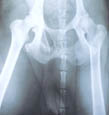
The dog has a incorrectly formed hip joint. By constant use of the joint, it becomes more and more loose, wears abnormally and may become arthhritic. Dogs who are affected often walk in a peculair manner and always sit with both legs together on one side of their body.
 
  see for more info:
Zinc Responsive D.
Pet Education
Huskies Domain/Zinc

Zinc Responsive Dermatosis (Zinc Deficiency)
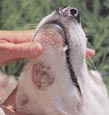
This condition starts with the forming of greybrown crusted layers followed by hairloss around these crusts and resulting in red open skinwounds, primarily around the lips, chin and eyelids and possibly at the feet, hocks and elbows. Most common in prepubertal Siberians and Alaskan Malamutes.


vargevass homepage | home | breedstandard | breedtypes | portraits | colors | behaviour | health

www.vargevass.com, www.siberianhusky.nl, © Eveline Koch, webmaster@vargevass.com, May 2004